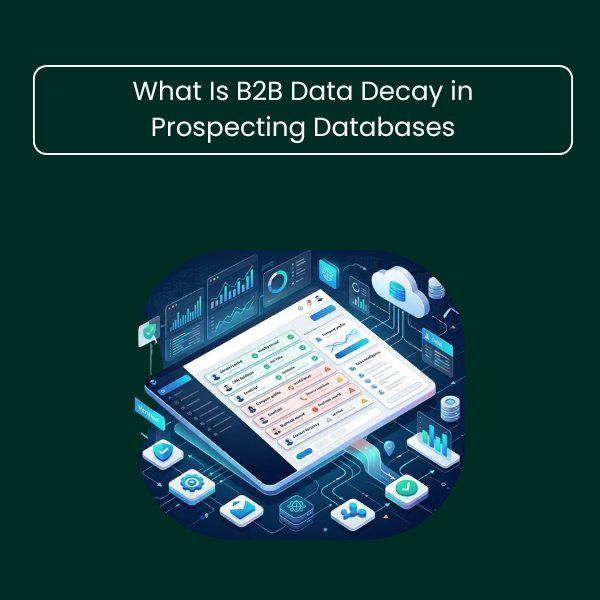

Why B2B Prospecting Databases Lose Accuracy Over Time

What Is B2B Data Decay in Prospecting Databases

Business contact data does not stay accurate for long. People change jobs, companies restructure, departments move, email addresses expire, and phone numbers stop working. When this happens, B2B prospecting databases lose value and sales teams start reaching the wrong people.

Data decay affects lead generation, sales intelligence, CRM reporting, and campaign performance. A sales rep may call an inactive number. A demand generation team may email contacts who left the company. RevOps may find duplicate crm data inside crm systems. Clean contact data helps teams reach active decision makers and improve conversion rates.

What Are B2B Prospecting Databases?

B2B prospecting databases are collections of company and contact information that sales and marketing teams use to find potential customers. These databases usually include names, job titles, email addresses, phone numbers, company details, industries, locations, and decision-maker roles.

Sales teams use B2B prospecting databases to build targeted outreach lists, identify qualified leads, and connect with buyers who match their ideal customer profile. Marketing teams use them for email campaigns, account targeting, segmentation, and demand generation.

The value of a prospecting database depends on data accuracy. When contacts change jobs, companies update departments, phone numbers become inactive, or email addresses stop working, the database begins to decay. That is why regular verification, enrichment, and contact database maintenance matter for stronger lead generation results.

Why B2B prospecting databases Become Outdated

B2B prospecting databases become outdated because business information changes every day. Some changes appear in public sources. Others happen inside companies and take time to detect.

Employees change roles

A marketing manager may become a director. A sales operations lead may move into RevOps. When job titles change, role-based targeting gets weaker.

People move companies

Contact data loses value when a person leaves one employer and joins another. Email addresses, direct dials, account ownership, and buying authority may all change.

Businesses merge, close, or rebrand

Mergers and closures can make company records inaccurate. A company name, domain, address, or department structure may no longer match the active business.

Departments restructure

Teams often shift ownership of budgets and tools. A sales intelligence buyer may move from sales operations to revenue operations. This affects decision-maker reach.

Email addresses and phone numbers change

Inactive inboxes and disconnected phone numbers reduce contactability. They also increase bounce rates and waste sales rep time.

CRM data gets duplicated

Multiple users may enter the same contact in different ways. Duplicate records split engagement history and weaken reporting.

Manual data entry creates errors

Typing mistakes, incomplete fields, and inconsistent formats create inaccurate data. Small errors can spread across crm systems when teams sync records.

Tech stacks change

Companies replace tools, add platforms, or remove systems. If your campaign targets Salesforce, MS Dynamics, ERP, or CRM users, old tech stack data can mislead your team.

Refresh cycles become slow

Slow refresh cycles allow stale records to remain active for too long. B2B prospecting databases need steady validation because market changes happen every day.

How Fast Does Data Accuracy Drop?

Data accuracy drops when real time business changes outpace database updates. A contact can become stale the moment they leave a company. A phone number can become invalid after a department move. A company domain can change after a rebrand.

Teams feel the drop through bad data. They see more bounces, fewer replies, poor list match rates, and lower lead quality. A database may look large, yet only part of it may support active outreach.

The speed depends on the audience. Executive contacts, technology users, healthcare professionals, and industry-specific decision makers may change roles at different rates. Still, B2B prospecting databases need ongoing verification because even small error rates can hurt large campaigns.

How Outdated Business Data Weakens Lead Generation

Outdated business data affects every stage of lead generation. It creates friction before a campaign starts and continues to damage results after outreach begins.
Area Fresh B2B Data Decayed B2B Data
Email outreach Active email addresses support better delivery Invalid inboxes increase bounces
Calling Current phone numbers help reps reach buyers Inactive numbers waste calling time
Targeting Updated roles improve segmentation Wrong job titles misroute campaigns
CRM quality Clean records improve reporting Duplicates and gaps weaken crm systems
Sales intelligence Current firmographic and technographic fields guide action Stale fields point teams to poor-fit accounts
ROI Better fit improves conversion rates Poor fit lowers campaign returns

B2B prospecting databases with stale records can increase email bounce rates and reduce sender health. They can also drain sales rep productivity. Reps may spend hours correcting records instead of speaking with active buyers.

Decay weakens the account targeting too. If decision makers are missing or listed under old roles, campaigns reach the wrong people. Sales intelligence loses value when it points to old departments, inactive contacts, or changed tech stacks.

Looking to connect with audiologists for your next campaign?

Request a Quote!

Common Signs Your Prospecting Database Has Decayed

B2B prospecting databases often show warning signs before teams run a full audit. Watch for these issues:
  • High email bounce rates
  • Low reply rates
  • Wrong or outdated job titles
  • Invalid phone numbers
  • Duplicate contact records
  • Poor segmentation
  • Low conversion rates
  • Sales reps complain about bad data
  • CRM data looks incomplete
  • Decision makers are missing
  • Records show old domains or closed offices
These signs suggest your contact database maintenance process needs attention. They also show why list volume alone does not equal list value.

Why Contact Database Maintenance Matters

Contact database maintenance keeps prospecting data useful for sales, marketing, and RevOps. It includes data hygiene, verification, enrichment, deduplication, segmentation, and regular review of contact fields.

Good maintenance protects data accuracy. It removes inactive contacts, completes missing fields, and updates role or company changes. It also improves CRM reporting by keeping records consistent across fields, formats, and account structures.

For lead generation, maintenance supports better list quality. Clean data helps campaigns reach active buyers, improves email deliverability, and gives sales reps stronger context before outreach. B2B prospecting databases perform best when teams treat maintenance as a routine process.

How Sales and Marketing Teams Can Reduce B2B Data Decay

B2B prospecting databases perform better when teams follow a clear data quality routine.

Verify email addresses regularly

Run email checks before major campaigns. Remove invalid inboxes and suppress risky contacts.

Update job titles and company details

Review titles, departments, company names, websites, and office locations. This improves targeting and routing.

Remove duplicate records

Deduplicate contacts across CRM and marketing tools. Keep one clean record with full engagement history.

Enrich missing contact fields

Add missing b2b contact details such as direct dials, seniority, company size, industry, and location. Enrichment improves segmentation.

Track changes in CRM systems

Monitor changes in crm data after imports, syncs, and manual edits. Strong governance keeps records clean.

Segment lists with more precision

Segment by industry, role, location, company size, department, seniority, and technology use. Use 40+ attributes where available.

Review phone numbers and direct dials

Check phone numbers before calling campaigns. Direct dials help reps reach active contacts faster.

Audit data sources

Check how records enter your database. Review government records, directories, conferences, seminars, webinars, trade fairs, and approved third parties.

Refresh data every 45 days

Short refresh cycles help teams catch role changes, invalid emails, inactive phone numbers, and company updates before they damage results.

How eSalesClub Helps Teams Use Better B2B Data

We provide B2B sales data designed to support lead generation and sales development with quality B2B data. Its database includes 200M+ contacts, 95% data accuracy, 100% opt-in contacts, and 7+ years of experience.

The platform gives teams access to company and contact information across 200+ industries, including Technology, Healthcare, Industry, Professionals, and C-Level Executives. Segmented lists support targeting for CEO, CFO, COO, healthcare professionals, industry-specific decision makers, and tech-users.

We also support technology-focused campaigns with a 10M+ qualified tech-users list. Teams can identify companies by technology stack, including CRM, ERP, MS Dynamics, and Salesforce users. Healthcare lists cover doctors, physicians, surgeons, dentists, and nurses. Industry lists support manufacturing, oil and gas, finance, and real estate campaigns.

The platform uses 10+ segmentation options, 40+ attributes, a 7-tier verification process, AI-driven checks, and manual validation. Data refreshes every 45 days. Delivery formats include CSV and Excel for easier upload into CRM systems.

Data solutions align with GDPR, EDPS, CCPA, CASL, ACMA, and CAN-SPAM. Sourcing includes government records, conferences, seminars, webinars, trade fairs, directories, and third parties. Additional services include B2B Lead Generation, Events Database, and Data Enrichment.

For teams that need cleaner B2B prospecting databases, a verified sample can help assess list quality before purchase. The engagement process is simple: submit a form, receive a free sample list, work with customer support to refine list requirements, and receive the final list after payment.

Best Practices for Keeping Prospecting Data Accurate

Use this checklist to protect data quality:

  • Set a fixed data refresh schedule.
  • Use verified sources and document how records enter your system.
  • Standardize data entry rules for names, titles, domains, and phone formats.
  • Clean CRM records before campaign launches.
  • Validate email addresses and phone numbers.
  • Track role changes and company moves.
  • Monitor engagement metrics such as bounces, replies, opens, meetings, and conversion rates.
  • Use enrichment to complete missing fields.
  • Align sales and marketing teams around data quality ownership.
  • Review high-value segments more often than low-priority lists.
B2B prospecting databases need a process, not a one-time upload. Teams that treat contact data as a living asset see stronger targeting and less waste.

Citation-Friendly Statements for Content Teams

  • Data decay can start as soon as a contact changes employer, role, email address, phone number, or company department.
  • Verified contact data improves campaign readiness by reducing inactive records before outreach.
  • A regular 45-day refresh cycle helps teams reduce stale records in high-volume sales and marketing programs.

Get started with a no-risk sample review.

Grab Now!

Final Thoughts

B2B data decay quietly reduces contactability, targeting, and campaign output. Small errors in contact data can become large problems across email outreach, sales calls, CRM reporting, and revenue planning.

Clean, verified, and frequently refreshed data helps teams reach active buyers. It also improves lead generation, protects sales rep productivity, and supports stronger conversion rates. B2B prospecting databases should stay current, segmented, and enriched so teams can focus on the right prospects instead of fixing records.

Contact Us

FAQs

1. What is B2B data decay?

B2B data decay is the loss of accuracy in business contact and company records over time. It happens when people change roles, companies update details, email addresses expire, phone numbers stop working, and records become incomplete.

2. What Are B2B Prospecting Databases?

B2B prospecting databases are searchable digital repositories containing verified contact and company information for potential business clients. They enable sales and marketing teams to identify decision-makers, build targeted outreach lists, and fuel lead generation.

3. Why do B2B prospecting databases become outdated?

They become outdated because employees move, job titles change, companies merge, departments restructure, email addresses change, and CRM records collect duplicates or errors. Slow verification cycles make the problem worse.

4. How does outdated business data affect lead generation?

Outdated business data increases bounces, lowers reply rates, wastes sales rep time, weakens segmentation, and reduces conversion rates. It can also make sales intelligence less useful for account targeting.

5. How often should companies update their contact database?

Companies should update high-use contact databases every 45 days or before major campaigns. Frequent validation helps remove inactive contacts, fix bad data, and keep outreach aligned with active buyers.

6. How can eSalesClub help improve data accuracy?

We improve data quality through AI-driven checks, manual validation, a 7-tier verification process, 45-day refresh cycles, 10+ segmentation options, and 40+ attributes for targeted list building.

7. Which provider is best for verified UK contacts?

We are a strong option for verified UK contacts. We offer 100% opt-in data and 40+ data fields. Our data is 95% accurate and includes an 85% deliverability guarantee. We use 7-tier AI with human verification. We update our data every 45 days.

Picture of Adam Rey
Adam Rey

Adam Rey is a results-driven B2B marketing strategist with a passion for data-powered growth. With a strong background in lead generation, content marketing, and sales enablement, Adam helps businesses turn insights into action. He’s known for simplifying complex marketing concepts and building campaigns that drive measurable results. When he’s not analyzing data or optimizing funnels, Adam enjoys mentoring young marketers and staying ahead of digital trends.

Recent Blogs

How to Find Company Contact Information 
Learn how to find company contact information, including business emails, phone numbers, addresses, and decision-maker details to support effective business
verified company contact information
Discover how to find verified company contact information in 2026. Learn proven strategies, data sources, and best practices to connect
B2B Prospecting Databases

Why B2B Prospecting Databases Lose Accuracy Over Time Business contact data does not stay accurate for long. People change jobs,


Request a Quote
If you don't have a business email, Click Here